
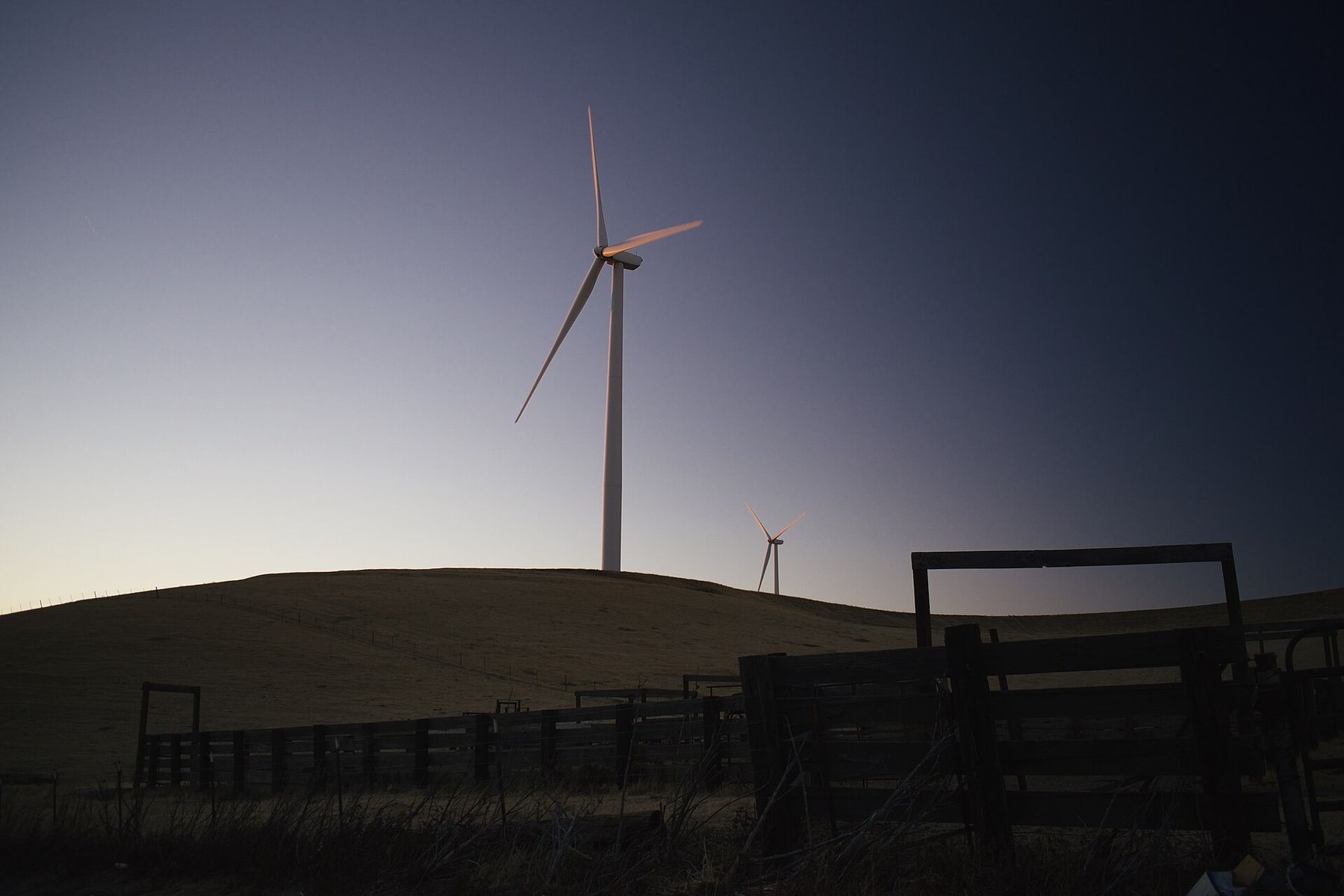
Turbines across the Altamont Pass at sunset: clean power built at scale.
Levi Clancy, Views of windmills and pasture land at sunset at Altamont Pass Wind Farm 01, 2018EcoAxes / Included ideologies / Left and socialist ecologies
Political currentEcomodernist Left
A current on today's left, associated with Leigh Phillips, Matthew Huber and writers around Jacobin magazine. It dismisses degrowth as austerity and answers climate change with public ownership of energy and industry, a fast build-out of clean power including nuclear, and material abundance for working people.
- Key figures
- Leigh Phillips, Matthew Huber, Michal Rozworski, Aaron Bastani, Holly Jean Buck
Where it stands
- Environmental EthicsAnthropocentrismEcocentrism
- Human–Nature RelationsHuman SeparationHuman Integration
- Ecological InterventionNoninterventionActive Stewardship
- Economic PhilosophyGreen GrowthPost-Growth
- Resource OwnershipPrivate StewardshipCommons Governance
- Environmental AuthorityCentralized AuthorityLocal Autonomy
- Environmental JusticeAggregate OutcomesDistributive Justice
- Technological OutlookTechnological OptimismEcological Precaution
- Energy PhilosophyEnergy AbundanceEnergy Sufficiency
- Conservation StrategySustainable UseStrict Protection
- Human–Wildlife RelationsHuman PriorityWildlife Accommodation
- Agricultural EcologyLand SparingLand Sharing
- Global ResponsibilityNational SovereigntyInternational Ecological Obligation
- Ecological Political PriorityIncremental ReformTransformative Change
Its firmest commitments are to growth and abundance, public ownership, rapid deployment of clean energy and technology, distributive justice for working people, and structural change of the economy. It values nature mainly for human flourishing and favours land-sparing intensive production. It differs from productivist socialism in being democratic and in treating climate change as a central problem.
Definition
The ecomodernist left joins socialist politics to the ecomodernist belief that environmental problems are solved by technology and abundance, not by limits. Climate change, it argues, should be solved by building: publicly owned clean electricity, nuclear power, high-speed rail, green steel and modern farming, on a scale only the state can organise.
It rejects degrowth as a politics of sacrifice that working people will never accept. It sees the fight over climate as a class struggle over who owns and controls energy and production.
Historical development
Leigh Phillips made the left’s case against degrowth in Austerity Ecology and the Collapse-Porn Addicts (2015). Phillips and Michal Rozworski argued in The People’s Republic of Walmart (2019) that large corporations already show democratic planning is possible. Matthew Huber argued in Climate Change as Class War (2022) that the climate movement has to be built among the industrial workers who produce energy and materials, and not among a professional class preaching less consumption.
The current has been prominent in Jacobin magazine and in arguments inside the Green New Deal coalition. It overlaps with Aaron Bastani’s “fully automated luxury communism”.
Principal claims
- Climate change can be solved by building clean abundance. Consuming less is not the answer.
- Degrowth asks working people to accept austerity, and it will never win them.
- Energy and key industries should be publicly owned and democratically planned.
- Nuclear power, advanced technology and intensive farming are allies in the fight against climate change.
- Climate politics is a class struggle, best fought through industrial workers and their unions.
Policy implications
The ecomodernist left supports public ownership of electricity and heavy industry, and huge state investment in clean power, nuclear included. It wants an industrial policy for green steel, cement and chemicals, high-speed rail and public transport, and intensive farming that spares land. All of it comes with strong labour rights and redistribution.
Internal disagreements
Its writers differ on how much to rely on nuclear power, on the role of markets in the transition, and on how far to embrace land sparing in agriculture. They also disagree about environmentalists who put biodiversity and wilderness first. Some see them as natural allies, others as part of a middle-class politics of limits.
Criticisms and controversies
Degrowth scholars such as Jason Hickel and Giorgos Kallis argue that no economy has decoupled growth from material use at the speed required, and that the current underrates ecological limits other than carbon. Conservationists worry that its enthusiasm for building discounts the habitat lost to mines, energy infrastructure and farms.
Its writers answer that only a politics of abundance can win majorities.
Relationships to other traditions
The ecomodernist left sits between green social democracy, with which it shares public investment and labour politics, and ecomodernism, with which it shares faith in technology and abundance. It is the democratic successor to productivist socialism. It is the main opponent on the left of degrowth and of ecosocialism’s emphasis on limits.
References and further reading
- Phillips, L. (2015). Austerity Ecology and the Collapse-Porn Addicts: A Defence of Growth, Progress, Industry and Stuff. Winchester: Zero Books.
- Phillips, L. and Rozworski, M. (2019). The People’s Republic of Walmart. London: Verso.
- Bastani, A. (2019). Fully Automated Luxury Communism. London: Verso.
- Huber, M. T. (2022). Climate Change as Class War: Building Socialism on a Warming Planet. London: Verso.
- Hickel, J. (2020). Less Is More: How Degrowth Will Save the World. London: Heinemann. (As critic.)