
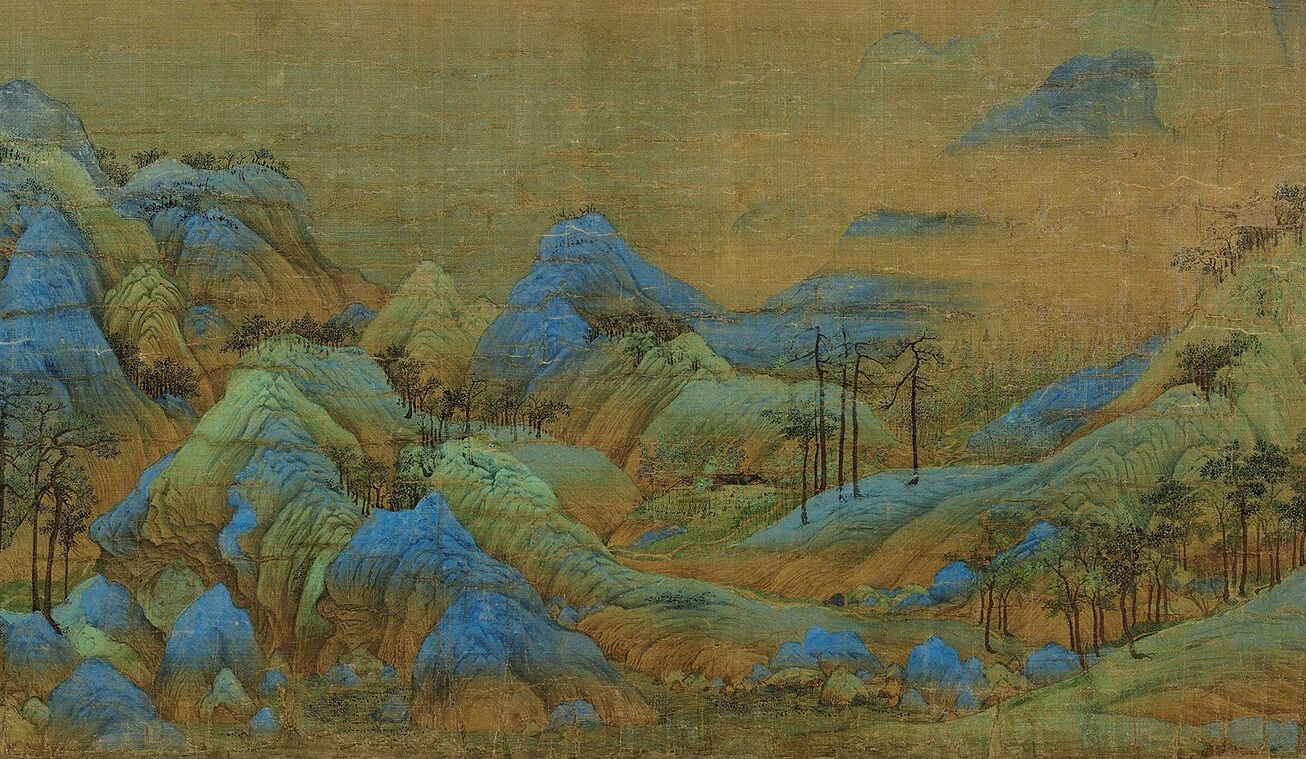
Wang Ximeng's A Thousand Li of Rivers and Mountains, 1113: mountains, pines and water in a single ordered cosmos, with a hamlet tucked in among them.
Wang Ximeng, Wang Ximeng - A Thousand Li of River (Start), 1096EcoAxes / Included ideologies / Religious and spiritual environmental ethics
Religious and philosophical environmental ethicConfucian Tianren Heyi
The Confucian ideal of tianren heyi, the unity of heaven and humanity, read as an environmental ethic. People complete a moral cosmos instead of standing outside it, so caring for nature belongs to self-cultivation, to duty toward ancestors and descendants, and to good government. A classical saying puts it: "the humane person forms one body with heaven, earth and the myriad things".
- Key figures
- Confucius and Mencius (tradition), Zhang Zai (the Western Inscription), Wang Yangming, Tu Weiming, Mary Evelyn Tucker
Where it stands
- Environmental EthicsAnthropocentrismEcocentrism
- Human–Nature RelationsHuman SeparationHuman Integration
- Ecological InterventionNoninterventionActive Stewardship
- Economic PhilosophyGreen GrowthPost-Growth
- Resource OwnershipPrivate StewardshipCommons Governance
- Environmental AuthorityCentralized AuthorityLocal Autonomy
- Environmental JusticeAggregate OutcomesDistributive Justice
- Technological OutlookTechnological OptimismEcological Precaution
- Energy PhilosophyEnergy AbundanceEnergy Sufficiency
- Conservation StrategySustainable UseStrict Protection
- Human–Wildlife RelationsHuman PriorityWildlife Accommodation
- Agricultural EcologyLand SparingLand Sharing
- Global ResponsibilityNational SovereigntyInternational Ecological Obligation
- Ecological Political PriorityIncremental ReformTransformative Change
Read from the classical and Neo-Confucian sources: human beings as part of a single moral order with heaven and earth (Zhang Zai's "Heaven is my father and earth my mother"), Mencius's rules for timely use of forests and fisheries, the duty of the ruler to govern for the people and the land, and filial obligation across generations. Its firmest commitments are to people within nature, ordered stewardship, government from above by the worthy, and gradual, tradition-guided change; its value is anthropocosmic, centred on humanity's place in the cosmos rather than on nature for its own sake.
Definition
Tianren heyi, “heaven and humanity united as one”, expresses the Confucian conviction that human beings belong to the natural order and complete it. Heaven brings things into being, earth sustains them and humanity completes them.
Read as an environmental ethic, this makes caring for nature a moral and political duty. It is part of being a good person, not a separate cause. A person grows in virtue by extending humane feeling (ren) outward, from family to community, to all people and at last to “the myriad things”. A ruler governs well when people and land flourish together. And each generation owes both its ancestors and its descendants a world kept in good order. The modern scholar Tu Weiming calls this outlook “anthropocosmic”: centred on humanity, but on humanity as part of the cosmos.
Historical development
The classical texts already set rules of restraint. Mencius advised that if axes go into the forests only in the proper season there will be more timber than can be used, and that fine nets should not be cast in ponds, so that fish stay plentiful. The Book of Rites sets seasonal limits on hunting, fishing and felling trees.
The Neo-Confucians of the Song and Ming dynasties built the metaphysics. Zhang Zai’s Western Inscription opens: “Heaven is my father and earth is my mother, and even such a small creature as I finds an intimate place in their midst”. Wang Yangming taught that the humane person forms one body with heaven, earth and all things.
From the 1990s, the Harvard conferences on world religions and ecology brought these ideas into environmental ethics, along with the volume Confucianism and Ecology (1998), edited by Mary Evelyn Tucker and John Berthrong. Chinese and Korean scholars have since drawn on them in debates about development, and in China in the debate over “ecological civilisation”.
Principal claims
- Humanity forms one body with heaven, earth and the myriad things. Harming nature damages the moral order that people belong to.
- Caring for nature extends humaneness (ren), which is learned first in the family and then widened.
- Resources should be used in season and in moderation, so that they renew themselves.
- Good government is responsible for the flourishing of people and land alike. Rulers and officials owe the land stewardship.
- Duties run across generations, to ancestors who handed the world on and to descendants who will inherit it.
- The right relationship between society and nature is harmony and order. Conquest is the wrong one.
Policy implications
Confucian environmental thinkers today support long-term planning by responsible government, moral education in restraint and frugality, and family and community responsibility for local environments. They value farmland tended with care, and they judge policy by its effect on future generations. Some use the tradition to support state-led environmental programmes. Others stress its teaching that government is legitimate only when it serves the people.
Internal disagreements
Scholars disagree about whether Confucianism’s hierarchy and its focus on human relationships help or limit it as an environmental ethic, since nature’s value reaches it through human moral life. They differ on whether tianren heyi describes a real historical ethic or a modern reconstruction. They also disagree about how far the tradition can be separated from political uses of it, including in China today.
Criticisms and controversies
Historians such as Mark Elvin, in The Retreat of the Elephants, show that imperial China cleared forests and drained wetlands on a huge scale whatever its ideals of harmony. Critics argue that the tradition’s human-centred outlook and its respect for authority have supported development as easily as restraint.
Defenders answer that every tradition falls short of its ideals, and that Confucian duty across generations suits long-term environmental problems unusually well.
Relationships to other traditions
Confucian ethics shares a cosmology of harmony with Daoism. It differs in prizing active cultivation and social order, where Daoism prizes spontaneity and non-interference. Its stress on inheritance and on duty across generations links it to green conservatism, and its picture of responsible government feeds into ecological civilisation. With Christian and Islamic stewardship it shares the idea of a human trust inside a larger moral order.
References and further reading
- Mencius, Mengzi 1A3 (on seasonal use of forests and fisheries).
- Zhang Zai, Ximing (The Western Inscription), 11th century.
- Tu, W. (1989). The continuity of being: Chinese visions of nature. In J. B. Callicott and R. T. Ames (eds.), Nature in Asian Traditions of Thought. Albany: SUNY Press.
- Tucker, M. E. and Berthrong, J. (eds.) (1998). Confucianism and Ecology: The Interrelation of Heaven, Earth, and Humans. Cambridge, MA: Harvard University Press.
- Elvin, M. (2004). The Retreat of the Elephants: An Environmental History of China. New Haven: Yale University Press.
- Ivanhoe, P. J. (2017). Oneness: East Asian Conceptions of Virtue, Happiness, and How We Are All Connected. Oxford: Oxford University Press.