
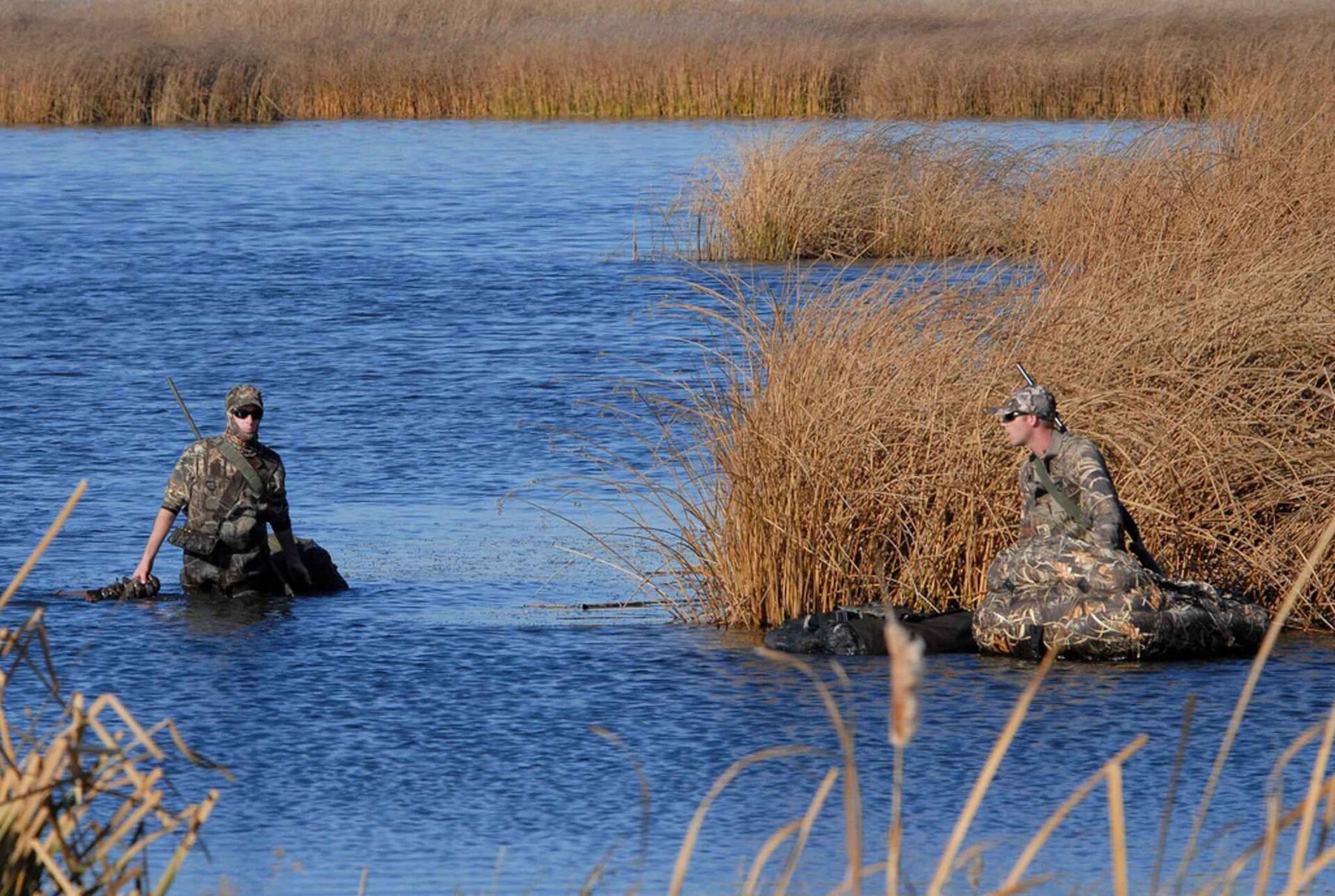
Waterfowl hunters in a marsh: the hunters whose licence fees and duck stamps pay to keep it.
U.S. Fish and Wildlife Service, Hunters wade through the wetlands while hunting for waterfowl, 2013EcoAxes / Included ideologies / Conservative and traditionalist environmentalism
Political and civic traditionConservation Conservatism
The tradition of hunters, anglers and rural landowners who have organised and paid for the conservation of wildlife and habitat since the late nineteenth century. It rests on the sustainable use of game and fish, hands-on habitat management, funding by the people who use wildlife, and local practical knowledge. Preservation and environmentalist ideology are not its foundations.
- Key figures
- Theodore Roosevelt, George Bird Grinnell, Aldo Leopold (as game manager), Ding Darling, Ducks Unlimited and the North American Model of Wildlife Conservation
Where it stands
- Environmental EthicsAnthropocentrismEcocentrism
- Human–Nature RelationsHuman SeparationHuman Integration
- Ecological InterventionNoninterventionActive Stewardship
- Economic PhilosophyGreen GrowthPost-Growth
- Resource OwnershipPrivate StewardshipCommons Governance
- Environmental AuthorityCentralized AuthorityLocal Autonomy
- Technological OutlookTechnological OptimismEcological Precaution
- Conservation StrategySustainable UseStrict Protection
- Human–Wildlife RelationsHuman PriorityWildlife Accommodation
- Ecological Political PriorityIncremental ReformTransformative Change
The tradition is explicit on sustainable use, active management and the role of hunters and anglers; its views on ownership (public game, private land) and governance (state agencies funded by licence fees, with local input) are mixed.
Definition
Conservation conservatism is the environmentalism of the sporting and rural tradition. From the 1870s on, hunters, anglers, ranchers and landowners organised to stop commercial hunting for markets. They created game laws and hunting seasons, paid for wildlife agencies through licence fees and taxes on equipment, and restored waterfowl habitat and game populations. For them, conservation means the wise and lasting use of wildlife by people who have a direct stake in it.
It is conservative in leaning on established institutions, private initiative and practical experience. It is also suspicious of urban environmentalists, who in its view want to protect nature without using it or understanding it.
Historical development
In 1887 George Bird Grinnell, editor of Forest and Stream, and Theodore Roosevelt founded the Boone and Crockett Club to campaign for the protection of game and for parks and forests. The historian John Reiger argued in American Sportsmen and the Origins of Conservation (1975) that sportsmen were the first conservationists, before the experts of the Progressive Era.
A system was built up law by law. The Lacey Act came in 1900 and the Migratory Bird Treaty in 1918. The Federal Duck Stamp followed in 1934, and in 1937 both the Pittman–Robertson excise tax on firearms, which funds state wildlife agencies, and the founding of Ducks Unlimited. The system was later written up as the “North American Model of Wildlife Conservation”. In it, wildlife is held in public trust, shared out by law and paid for by those who use it. Aldo Leopold’s Game Management (1933) gave it a science. Similar traditions exist in European game management and in the sustainable-use conservation of southern Africa.
Principal claims
- Wildlife and fish are renewable resources. They should be managed for lasting use, hunting and fishing included.
- Those who use wildlife should pay for its conservation and have a say in how it is managed.
- Active management of habitat is the heart of conservation. That includes restoring wetlands, controlled burning, planting food for wildlife and, where needed, controlling predators.
- Private landowners look after most habitat, and with the right incentives they look after it well.
- Practical local knowledge counts for more than ideology from far away. Conservation should be judged by its results.
Policy implications
The tradition supports game laws, seasons and licences, and wildlife agencies funded by their users. It backs programmes to restore wetlands, and easements and incentives for landowners. It accepts regulated sport and trophy hunting and resists bans on hunting, trapping and killing for control. It supports public access to public land alongside private stewardship.
Internal disagreements
Members disagree about predators, from controlling them actively to tolerating them. They differ on how far to work with the wider environmental movement, especially on climate. They weigh public land against private property differently, and they argue about the ethics of trophy hunting and of commercial game ranching.
Criticisms and controversies
Animal welfare advocates and wildlife protectionists object to hunting itself, and to management that favours game over other species. Ecocentrists object to treating wildlife as a resource. Environmental historians note that the public-trust model was built partly by shutting out Indigenous and subsistence hunters. Urban environmentalists and the sporting tradition have each accused the other of hypocrisy.
Supporters point to the return of deer, turkey, elk, waterfowl and wetlands across North America, paid for largely by hunters and anglers.
Relationships to other traditions
Conservation conservatism is the popular, user-based descendant of Gifford Pinchot’s conservationism and a practical relative of sustainable-use conservation. It shares green conservatism’s localism and the land ethic’s faith in landowners as stewards. It is opposed to wildlife protection, compassionate conservation and much of preservationism.
References and further reading
- Reiger, J. F. (1975). American Sportsmen and the Origins of Conservation. Winchester Press.
- Leopold, A. (1933). Game Management. Scribner.
- Organ, J. F. et al. (2012). The North American Model of Wildlife Conservation. The Wildlife Society Technical Review 12-04.
- Brinkley, D. (2009). The Wilderness Warrior: Theodore Roosevelt and the Crusade for America. HarperCollins.