
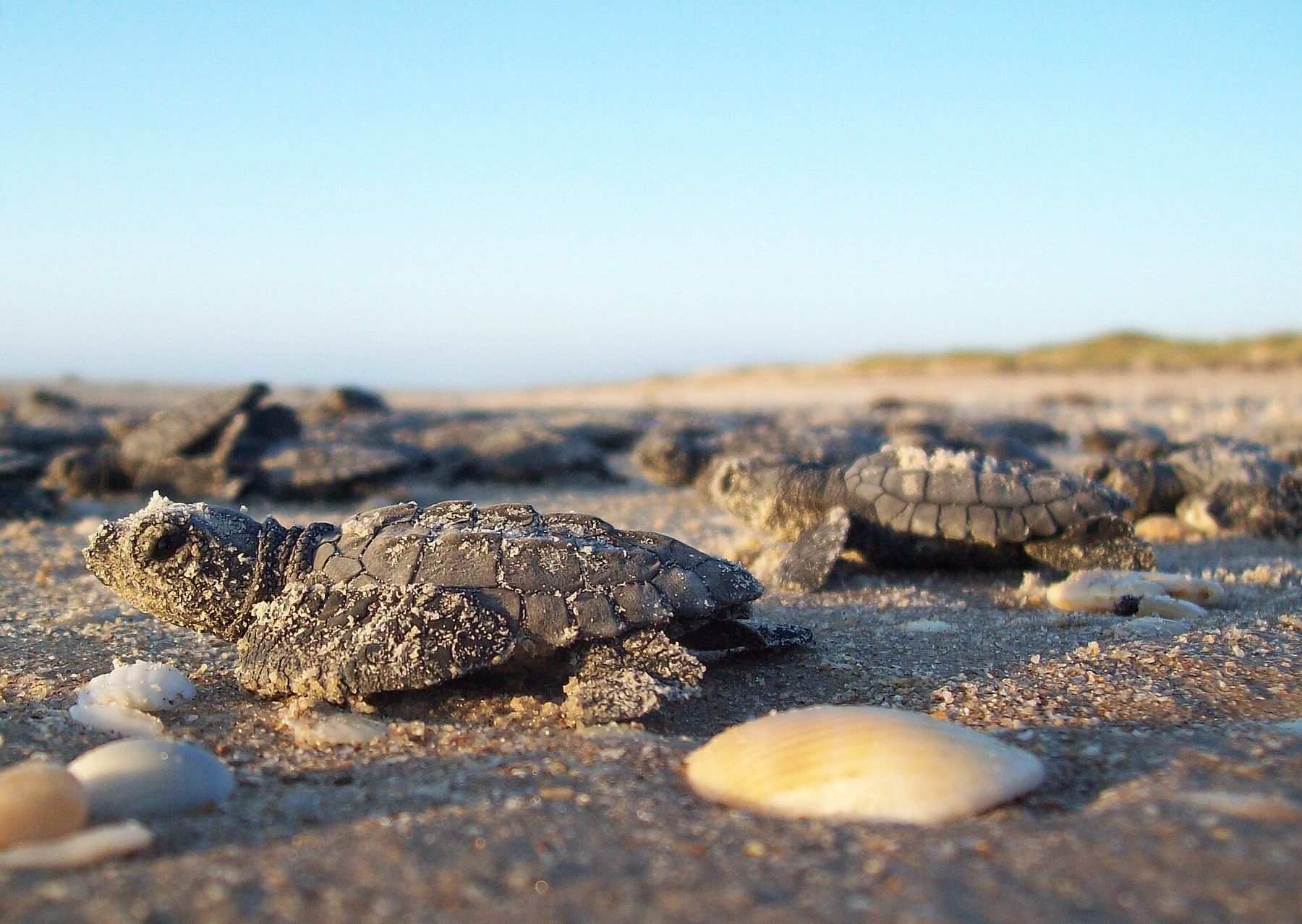
Kemp's ridley hatchlings released on Padre Island: each animal's life counted.
NPS Staff, 2010 Kemp's ridley sea turtle project at Padre Island National Seashore (for NRC), 2007EcoAxes / Included ideologies / Conservation philosophies and practice
Conservation ethic and movementCompassionate Conservation
The movement, given formal shape around 2010, that brings animal welfare ethics into conservation. It holds that the wellbeing of each wild animal matters morally and that conservation should "first do no harm". Wherever another way exists, it refuses to kill individual animals, invasive and overabundant ones included, for the sake of populations, species or ecosystems.
- Key figures
- Marc Bekoff, Daniel Ramp, Arian Wallach, Chelsea Batavia, Michael Paul Nelson
Where it stands
- Environmental EthicsAnthropocentrismEcocentrism
- Human–Nature RelationsHuman SeparationHuman Integration
- Ecological InterventionNoninterventionActive Stewardship
- Environmental JusticeAggregate OutcomesDistributive Justice
- Technological OutlookTechnological OptimismEcological Precaution
- Conservation StrategySustainable UseStrict Protection
- Human–Wildlife RelationsHuman PriorityWildlife Accommodation
- Agricultural EcologyLand SparingLand Sharing
Compassionate conservation is defined by its wildlife and intervention positions and by an individualist biocentric ethic; it takes no distinctive stand on economics or governance.
Definition
Compassionate conservation holds that conservation must treat the wellbeing of individual animals as a moral matter, alongside the fate of populations, species and ecosystems. Its proponents set out four guiding principles. First, do no harm. Individuals matter. Value all wildlife, including non-native species and those labelled pests. Seek peaceful coexistence.
In practice the movement opposes the killing of invasive and overabundant species, culling, killing predators to protect livestock or game, and research methods that kill animals. It prefers non-lethal alternatives, coexistence, and letting ecosystems settle into new balances.
It is a conservation movement and not an animal rights movement. But it brings the ethics of animal welfare and animal rights, which reason about individuals, into a field that has traditionally reasoned about groups.
Historical development
Animal welfare and conservation have long been at odds. The movement itself formed at a symposium in Oxford in 2010, organised by the Born Free Foundation and the University of Oxford’s Wildlife Conservation Research Unit. Marc Bekoff’s edited volume Ignoring Nature No More (2013) consolidated it. So did the Centre for Compassionate Conservation at the University of Technology Sydney, led by Daniel Ramp and Arian Wallach. Their 2018 paper “Summoning compassion to address the challenges of conservation” set out the principles.
Australia, with its debates over killing feral cats, dingoes, horses and camels, has been the main battleground. Conservation biologists have responded sharply, and the result is one of the fiercest ethical arguments in the field.
Principal claims
- Individual wild animals have moral standing. Their suffering and their deaths count.
- Killing individuals to benefit a population or an ecosystem needs a justification, and compassionate conservationists generally find none.
- Non-native species are not bad in themselves. “Invasive” is a label that carries value judgements, and new kinds of ecosystem have value.
- Predators should be left to regulate ecosystems. When humans take over that job, they swap one harm for another.
- Coexistence, non-lethal management and acceptance of change are the preferred tools.
Policy implications
The movement wants killing for control, culls and predator removal banned or tightly limited. It favours non-lethal ways of handling conflict, such as deterrents, fencing and changes to how livestock are kept. Non-native species that have become part of an ecosystem should be protected. It supports rewilding with predators in place of culling by people, welfare standards in conservation research, and compassion as one of the tests applied to policy.
Internal disagreements
Supporters disagree about whether “first do no harm” allows exceptions. Most allow some in extreme cases. They differ on how to weigh the suffering caused by predators, or by doing nothing, against the suffering caused by control. They also disagree about whether the movement should ally with animal rights or stay within conservation.
Criticisms and controversies
Conservation biologists argue that the movement would let many endangered species die out by refusing to control the invasive predators that threaten them. The standard example is the birds and mammals of Australian islands. They say it confuses sentiment with ethics, ignores the suffering of prey when predators go unchecked and the collapse of whole ecosystems, and reflects the distance of city dwellers from land management.
Proponents answer that their critics take the right to kill for granted without arguing for it, that lethal control often fails anyway, and that conservation’s ethic of groups has never justified how it treats individuals.
Relationships to other traditions
Compassionate conservation shares biocentrism’s focus on individuals and wildlife protection’s opposition to killing. It supports rewilding where predators take over the work of human control, and opposes the culling that rewilding sometimes involves. It is the strongest opponent of sustainable-use conservation, of the hunting economy in CBNRM, and of the lethal management accepted by conservationism and by most protected-area practice.
References and further reading
- Wallach, A. D., Bekoff, M., Batavia, C., Nelson, M. P. and Ramp, D. (2018). “Summoning compassion to address the challenges of conservation.” Conservation Biology 32(6), 1255–1265.
- Bekoff, M., ed. (2013). Ignoring Nature No More: The Case for Compassionate Conservation. University of Chicago Press.
- Ramp, D. and Bekoff, M. (2015). “Compassion as a practical and evolved ethic for conservation.” BioScience 65(3), 323–327.
- Hayward, M. W. et al. (2019). “Deconstructing compassionate conservation.” Conservation Biology 33(4), 760–768. (The principal critique.)
- Oommen, M. A. et al. (2019). “The fatal flaws of compassionate conservation.” Conservation Biology 33(4), 784–787.