
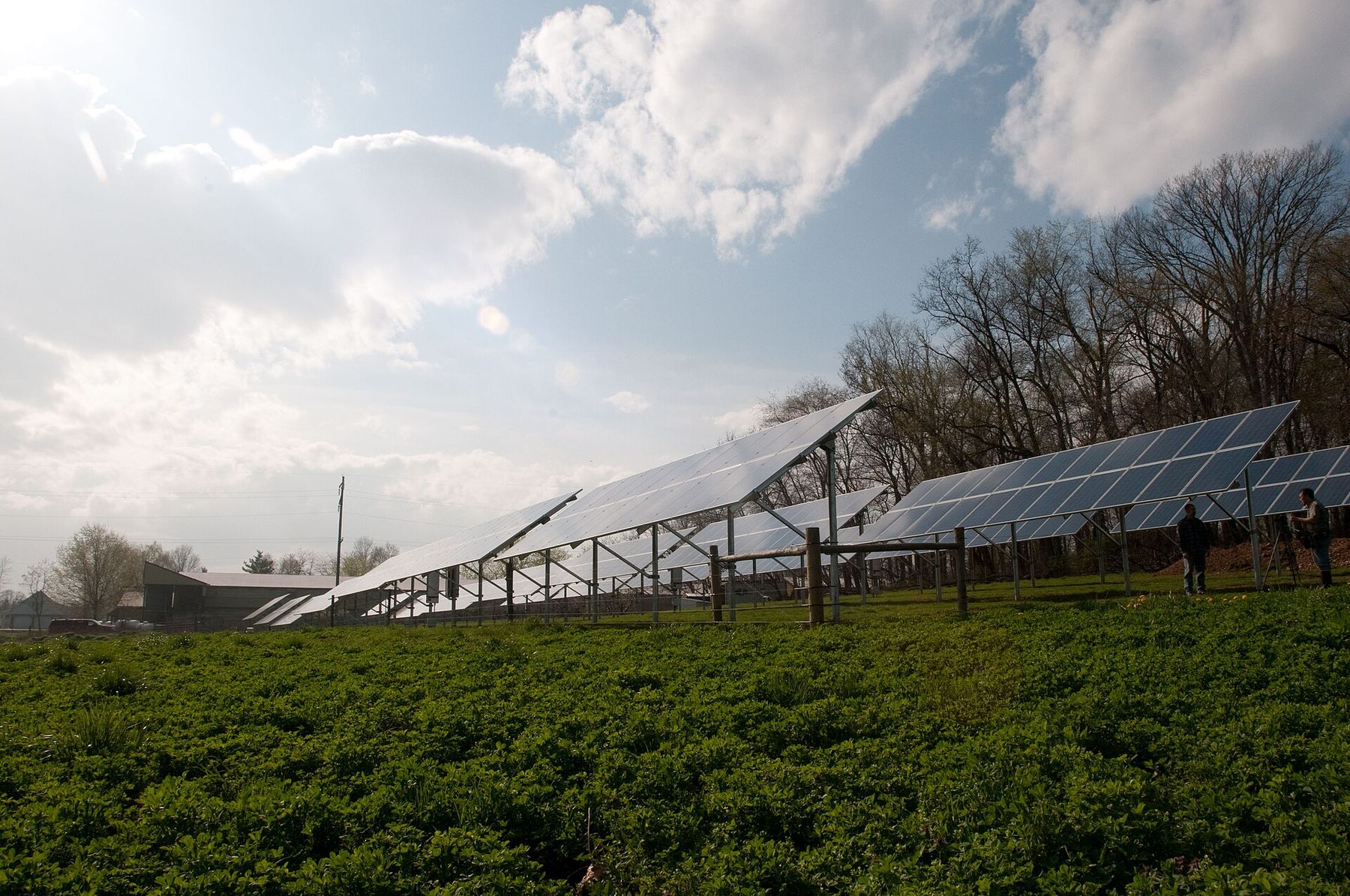
A solar array set into green farmland: clean energy designed to sit lightly on the land.
U.S. Department of Agriculture, 20110420-RD-LSC-0107 - Flickr - USDAgov, 2011EcoAxes / Included ideologies / Technological and modernist environmentalism
Environmental orientationBright Green Environmentalism
The outlook Alex Steffen named in 2003. It holds that sustainability will come from better design, clean technology, dense well-planned cities and invention, and not from sacrifice. It sets itself apart from "dark green" calls for simple living and from "light green" shopping gestures. It includes natural capitalism, Paul Hawken and Amory and Hunter Lovins's programme of much more productive use of resources, copying nature's designs and reinvesting in ecosystems, so that business helps repair the environment.
- Key figures
- Alex Steffen and Worldchanging, Bruce Sterling (Viridian design), William McDonough and Michael Braungart (cradle to cradle), Amory Lovins
Where it stands
- Environmental EthicsAnthropocentrismEcocentrism
- Human–Nature RelationsHuman SeparationHuman Integration
- Economic PhilosophyGreen GrowthPost-Growth
- Resource OwnershipPrivate StewardshipCommons Governance
- Environmental AuthorityCentralized AuthorityLocal Autonomy
- Environmental JusticeAggregate OutcomesDistributive Justice
- Technological OutlookTechnological OptimismEcological Precaution
- Energy PhilosophyEnergy AbundanceEnergy Sufficiency
- Conservation StrategySustainable UseStrict Protection
- Agricultural EcologyLand SparingLand Sharing
- Ecological Political PriorityIncremental ReformTransformative Change
Bright green is a design-and-innovation orientation rather than a programme; it is firm on technology and on growth-compatible prosperity, moderate and uncertain on most governance and justice questions.
Definition
Bright green environmentalism holds that the tools for a sustainable society already exist or can be invented, and that the environmental movement’s job is to design them and put them to use. It has in mind renewable energy, efficient and good-looking buildings, dense cities people can walk around, manufacturing that reuses its materials, smart infrastructure, sustainable products, and networks and institutions that spread good ideas quickly.
It rejects the “dark green” message that a sustainable life means giving things up. A sustainable future, it argues, can be richer, more pleasant and more desirable than the present. It also rejects “light green” environmentalism, the small consumer gestures that change nothing. Alex Steffen summed up its aim as “a planet of bright green cities.”
Historical development
Steffen coined the term in 2003 on Worldchanging, the blog he co-founded, and turned it into a book, Worldchanging: A User’s Guide for the 21st Century (2006). Others had prepared the way. Bruce Sterling’s Viridian Design Movement (1998–2008) called for a stylish environmentalism led by design. William McDonough and Michael Braungart’s Cradle to Cradle (2002) proposed products designed to become nutrients for new ones. Amory Lovins treated efficiency as the first and cheapest resource.
Bright green ideas shaped the green building, clean technology and smart city movements of the 2000s and 2010s, and fed into ecomodernism. It differs from ecomodernism in caring less about nuclear power and intensive farming and more about renewables, cities and design.
Principal claims
- Technology, design and invention are what make a society sustainable. Restraint is not the lever.
- A sustainable society can be more prosperous and attractive than today’s, which means sustainability can win people over.
- Well-designed cities are the most sustainable way for people to live.
- Products and systems should be designed as closed loops, so that waste is never created.
- Information, networks and openness spread solutions faster.
Policy implications
Bright greens want investment in renewable energy, efficiency and power grids. They support green building codes, compact cities built around public transport, rules that make producers responsible for their products’ whole life, support for innovation, and open data. They are more at ease with markets and city governments than with national planning, and they take no firm position on ownership.
Internal disagreements
Bright greens disagree about nuclear power. Steffen doubted it, and many others accept it. They differ over ecomodernism’s push for intensive farming and land sparing, and over whether their optimism about design survives the evidence on rebound effects, where efficiency gains lead to more consumption. They also weigh differently what consumers, companies and governments should each do.
Criticisms and controversies
Dark green and degrowth critics say bright green optimism ignores scale, rebound effects and the limits of swapping one resource for another, and that it is a comfortable creed for well-off city dwellers. Justice critics say it has little to say about who will get to live in the bright green cities. Ecomodernists say it is too timid about nuclear power and intensive farming.
Its supporters point out that the clean technology and green building industries it championed have grown faster than anyone predicted.
Relationships to other traditions
Bright green environmentalism is ecomodernism’s neighbour, more interested in design and renewables. It is the popular face of natural capitalism and ecological modernisation. It defines itself against the “dark green” of deep ecology, degrowth and anarcho-primitivism, and against the “light green” of consumer environmentalism.
References and further reading
- Steffen, A., ed. (2006). Worldchanging: A User’s Guide for the 21st Century. Abrams.
- McDonough, W. and Braungart, M. (2002). Cradle to Cradle: Remaking the Way We Make Things. North Point Press.
- Sterling, B. (1998). “The Manifesto of January 3, 2000.” Viridian Design Movement.
- Lovins, A. B., Lovins, L. H. and Hawken, P. (1999). Natural Capitalism. Little, Brown.