
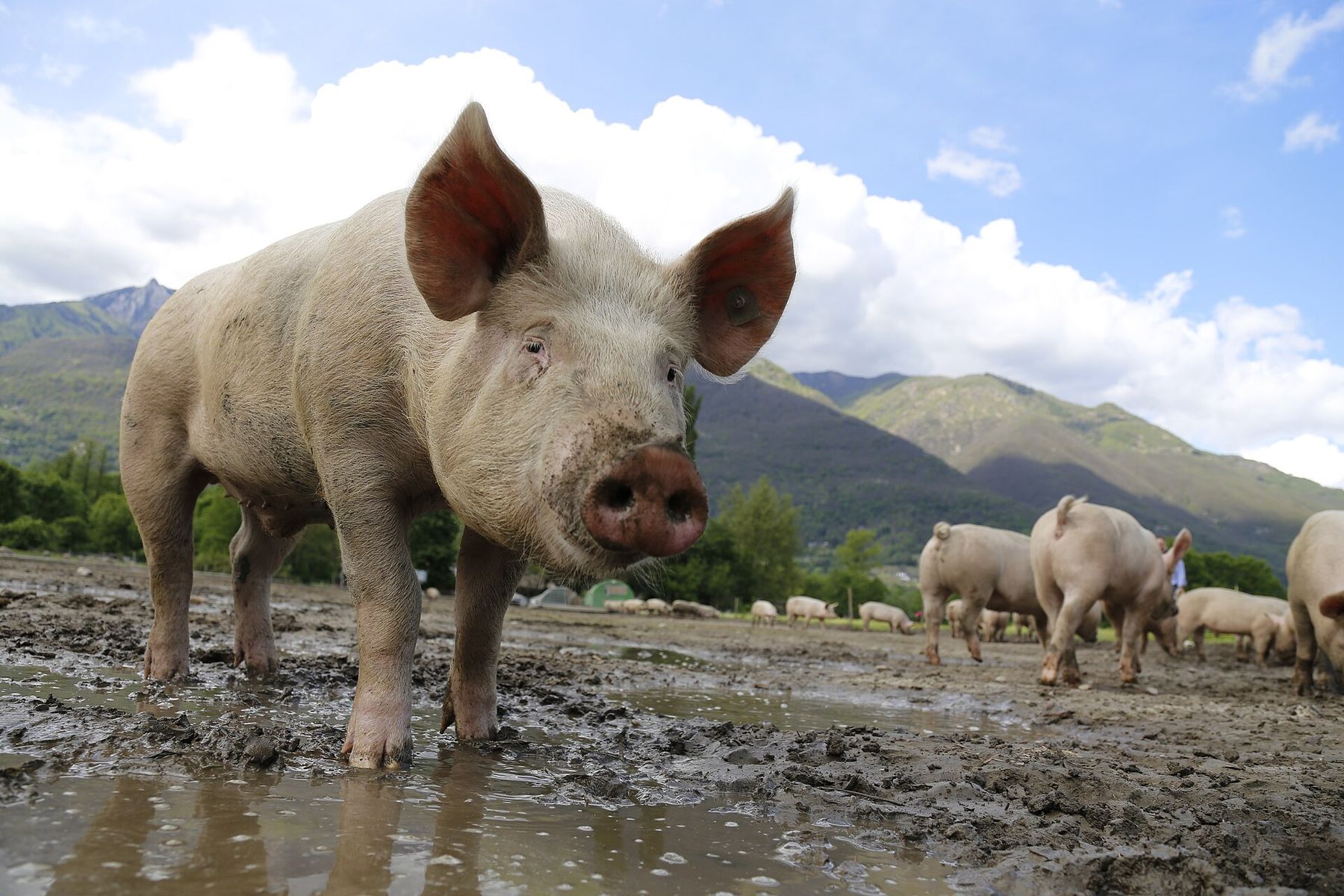
A pig looks into the camera: one individual, with a life of its own.
Farm-wildlife-herd-pasture-livestock-mammal-732554-pxhere, 2015EcoAxes / Included ideologies / Conservation philosophies and practice
Ethical theory and social movementAnimal Liberation
The movement and ethic grounded in Peter Singer's Animal Liberation (1975) and Tom Regan's The Case for Animal Rights (1983). It holds that a sentient animal's interests count as much as similar human interests, which makes factory farming, most meat-eating, animal experiments and the hunting and trapping of wild animals serious wrongs, and it calls for an end to treating animals as property.
- Key figures
- Peter Singer, Tom Regan, Gary Francione, Martha Nussbaum, Lori Gruen
Where it stands
- Environmental EthicsAnthropocentrismEcocentrism
- Human–Nature RelationsHuman SeparationHuman Integration
- Ecological InterventionNoninterventionActive Stewardship
- Economic PhilosophyGreen GrowthPost-Growth
- Resource OwnershipPrivate StewardshipCommons Governance
- Environmental AuthorityCentralized AuthorityLocal Autonomy
- Environmental JusticeAggregate OutcomesDistributive Justice
- Technological OutlookTechnological OptimismEcological Precaution
- Energy PhilosophyEnergy AbundanceEnergy Sufficiency
- Conservation StrategySustainable UseStrict Protection
- Human–Wildlife RelationsHuman PriorityWildlife Accommodation
- Agricultural EcologyLand SparingLand Sharing
- Global ResponsibilityNational SovereigntyInternational Ecological Obligation
- Ecological Political PriorityIncremental ReformTransformative Change
Its firmest commitments are to the moral standing of individual sentient animals and to wildlife's claims over human convenience, together with a demand for deep change in how society treats animals. Its distinctive concern, the use of animals in farming and research, is measured by the animals-as-property marker rather than by the dimensions, so its positions on growth, ownership and technology carry wide bands.
Definition
Animal liberation holds that animals’ suffering and interests matter morally for their own sake. Drawing the line of moral concern at our own species is, on this view, as arbitrary as drawing it at race or sex.
The movement has two main philosophical foundations. Peter Singer, a utilitarian, called the refusal to give animals’ interests equal consideration “speciesism”. Tom Regan, writing about rights, argued that animals who are “subjects of a life” have inherent value and may never be used merely as means. The two routes reach the same conclusion. Industrial use of animals is one of the great wrongs of our time, and factory farming above all, since it kills tens of billions of land animals every year. Most uses of animals for food, clothing, entertainment and research cannot be justified.
Historical development
Jeremy Bentham prepared the ground when he wrote that “the question is not, Can they reason? nor, Can they talk? but, Can they suffer?”. So did Henry Salt’s Animals’ Rights (1892).
The modern movement began around 1970 with a group of Oxford philosophers and with Singer’s Animal Liberation (1975). Regan’s The Case for Animal Rights followed in 1983. PETA, founded in 1980, and campaigns against fur, cosmetics testing and factory farming spread the cause worldwide. Gary Francione argued for an abolitionist, vegan programme.
Since 2000 the movement has concentrated on farmed animals, plant-based and cultivated meat, and legal personhood for animals. The political theorists Sue Donaldson and Will Kymlicka extended the ideas of citizenship and sovereignty to animals in Zoopolis (2011).
Principal claims
- A sentient animal’s interests deserve the same consideration as comparable human interests.
- Speciesism, which favours humans simply for being human, is a prejudice of the same kind as racism or sexism.
- Factory farming causes suffering on an enormous scale and is a grave wrong.
- Animals should not be treated as property or as resources for human use.
- Moral claims belong to individual animals. Species and populations matter too, but they are not the only bearers of claims.
Policy implications
The movement wants factory farming ended, and abolitionists want all animal farming ended. It supports a move to plant-based diets and alternative proteins, and bans on fur, on cosmetics testing and on most animal experiments. It opposes hunting and trapping, and it wants animals given legal rights or standing and wildlife managed without killing.
Internal disagreements
The deepest division is between welfarists and abolitionists. Welfarists want to reduce suffering by improving how animals are treated. Abolitionists reject any use of animals at all.
A second division concerns wild animals. Some think our only duty is to stop harming them. Others think we may also owe them help against suffering that has natural causes. A third, sharpened by conservation debates, is whether it can ever be right to kill invasive or overabundant animals to protect an ecosystem.
Criticisms and controversies
The environmental ethicist J. Baird Callicott argued that animal liberation conflicts with ecology. It values individual animals, while ecology values species and ecosystems, and its logic would condemn predation. Critics from farming and Indigenous communities say it brushes aside traditional and subsistence uses of animals. Others question the tactics of the movement’s direct-action wing.
Supporters answer that the scale of suffering in industrial farming dwarfs these disputes, and that animal farming is also among the leading causes of deforestation, emissions and loss of biodiversity.
Relationships to other traditions
Animal liberation is the widest form of the concern for individual animals that compassionate conservation applies to wildlife. It shares biocentrism’s extension of moral standing beyond humans. Ecofeminists have linked the domination of animals with the domination of women, Carol Adams most influentially, and the Jain principle of ahimsa is the oldest religious version of the same ethic. Its focus on individuals puts it at odds with the ecocentrism of deep ecology and the land ethic, which value wholes.
References and further reading
- Singer, P. (1975). Animal Liberation. New York: New York Review/Random House.
- Regan, T. (1983). The Case for Animal Rights. Berkeley: University of California Press.
- Callicott, J. B. (1980). Animal liberation: a triangular affair. Environmental Ethics, 2(4), 311–338.
- Adams, C. J. (1990). The Sexual Politics of Meat. New York: Continuum.
- Francione, G. L. (2008). Animals as Persons. New York: Columbia University Press.
- Donaldson, S. and Kymlicka, W. (2011). Zoopolis: A Political Theory of Animal Rights. Oxford: Oxford University Press.