
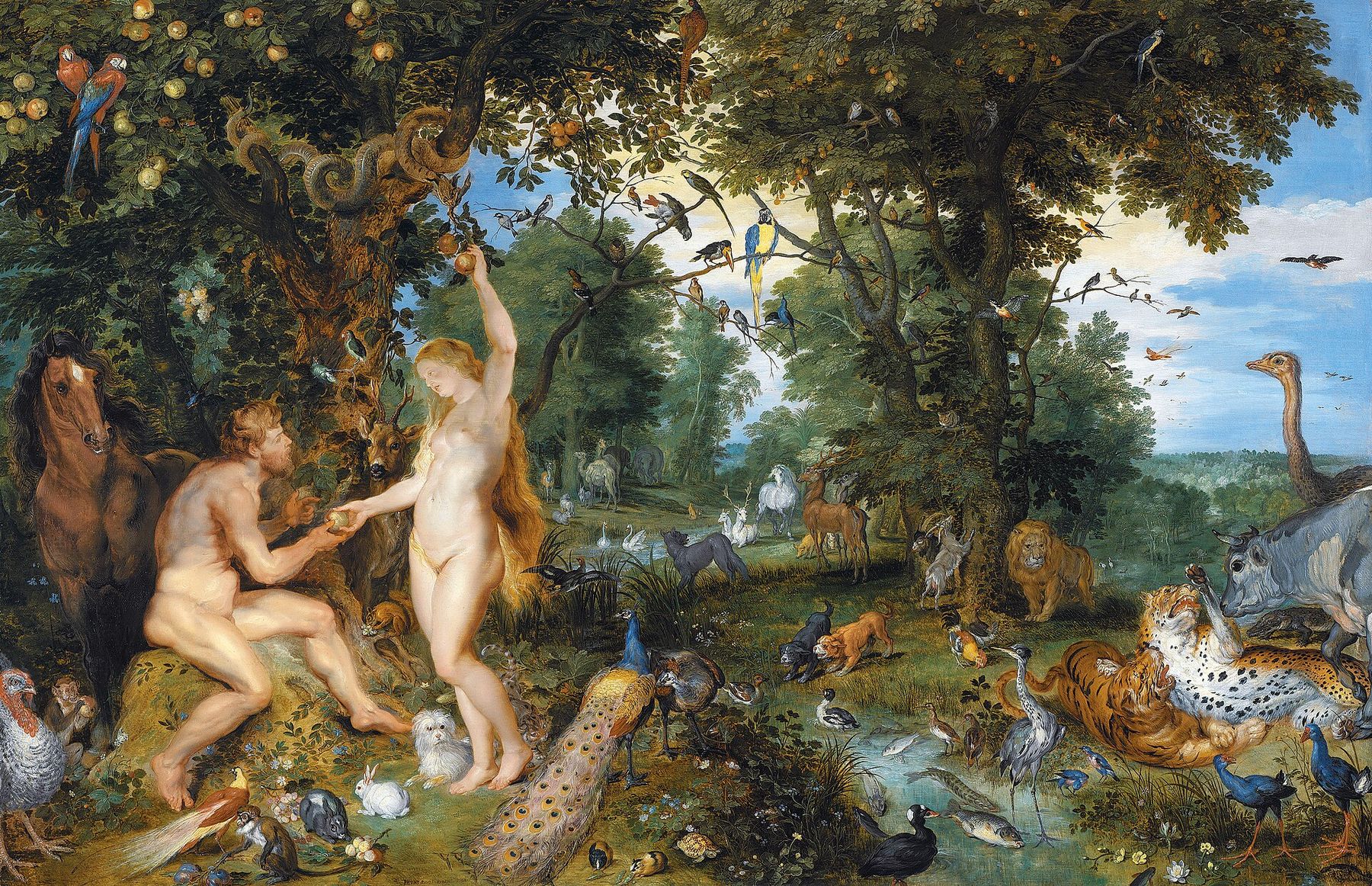
Rubens and Brueghel's Eden: the garden and its creatures given to humanity.
Peter Paul Rubens / Jan Brueghel the Elder, Portuguese: O jardim do Éden e a queda do homem The Garden of Eden with the Fall of Man, 1615EcoAxes / Included ideologies / Classical environmental philosophies
Ethical theoryAnthropocentrism
The position that moral value and moral standing belong to human beings. Duties about the environment are then duties owed to people, now and in the future, and not to nature itself.
- Key figures
- John Passmore, Bryan Norton (weak anthropocentrism), William Baxter, Immanuel Kant (indirect duties, as an antecedent)
Where it stands
- Environmental EthicsAnthropocentrismEcocentrism
- Ecological InterventionNoninterventionActive Stewardship
- Economic PhilosophyGreen GrowthPost-Growth
- Technological OutlookTechnological OptimismEcological Precaution
- Energy PhilosophyEnergy AbundanceEnergy Sufficiency
- Conservation StrategySustainable UseStrict Protection
- Human–Wildlife RelationsHuman PriorityWildlife Accommodation
Anthropocentrism is a theory of value, not a programme, so only the ethics axis is scored with confidence. The rest describe the tendencies that follow from valuing nature for people: managing it actively, using it, and trusting growth and technology to serve human ends. They carry wide uncertainty.
Definition
In environmental ethics, anthropocentrism is the view that human beings alone have intrinsic moral value, or at least that only human interests create moral obligations. Nature matters to the extent that it matters to people. It gives them health, livelihoods, beauty, knowledge, recreation and spiritual meaning, and it will matter in the same ways to future generations.
This is the working ethic of most law and policy. Some philosophers also defend it openly as the only coherent foundation for environmental duties.
Historical development
Environmental ethicists first used the word in the 1970s, as a criticism. Richard Routley, Arne Naess and others argued that Western ethics had to be extended beyond humans. John Passmore answered them in Man’s Responsibility for Nature (1974). He argued that Western traditions of stewardship and of working with nature could, properly developed, support all the environmental duties we need, without giving rights to nature.
Bryan Norton later separated two versions. “Strong” anthropocentrism values nature only for satisfying the preferences people happen to feel. “Weak” anthropocentrism values it according to considered preferences, open to rational revision, and to the ideals of a culture. Norton argued that the weak version can justify almost everything environmentalists want. Economists and utilitarians have defended an explicit cost-benefit form of anthropocentrism since at least William Baxter’s People or Penguins (1974).
Principal claims
- Moral standing belongs only to beings with interests of the right kind. In most versions, that means persons.
- Environmental duties are real but indirect. They are duties to present and future people, about nature.
- Nature’s value is instrumental, or at most a matter of human ideals and ways of living.
- Policy should therefore be judged by its effects on human welfare, understood broadly.
Policy implications
Anthropocentrism does not decide any policy by itself. It decides what counts when policy is made. With a long time horizon and a full account of human welfare, it supports a great deal of conservation. With a short horizon and narrow preferences, it supports very little. Its typical tools are cost-benefit analysis, environmental impact assessment and the valuation of ecosystem services.
Internal disagreements
Anthropocentrists disagree about whether future generations count and how much. They disagree about whether sentient animals have standing. Many accept that they do, a position often called sentientism, which blurs the boundary of the view. They differ over whether the aesthetic and spiritual value of nature is a preference like any other or something more. And some question whether “weak” anthropocentrism is anthropocentric at all.
Criticisms and controversies
Opponents argue that anthropocentrism cannot explain why it is wrong to harm nature in ways that affect no person, and that it permits extinction whenever the numbers favour it. Deep ecologists see it as the root of the ecological crisis.
Pragmatists answer that weak anthropocentrists and ecocentrists agree on almost every policy, so the dispute matters less than it appears. Strong anthropocentrists answer that theories giving moral value to rocks and rivers make no sense.
Relationships to other traditions
Anthropocentrism underlies shallow ecology, conservationism, environmental economics, most thinking on sustainable development and much religious stewardship ethics. Biocentrism, ecocentrism and deep ecology oppose it. Environmental pragmatism tries to bridge the two sides.
References and further reading
- Passmore, J. (1974). Man’s Responsibility for Nature. Duckworth.
- Norton, B. G. (1984). “Environmental ethics and weak anthropocentrism.” Environmental Ethics 6(2), 131–148.
- Baxter, W. F. (1974). People or Penguins: The Case for Optimal Pollution. Columbia University Press.
- Routley, R. (1973). “Is there a need for a new, an environmental, ethic?” Proceedings of the XVth World Congress of Philosophy, 205–210.