
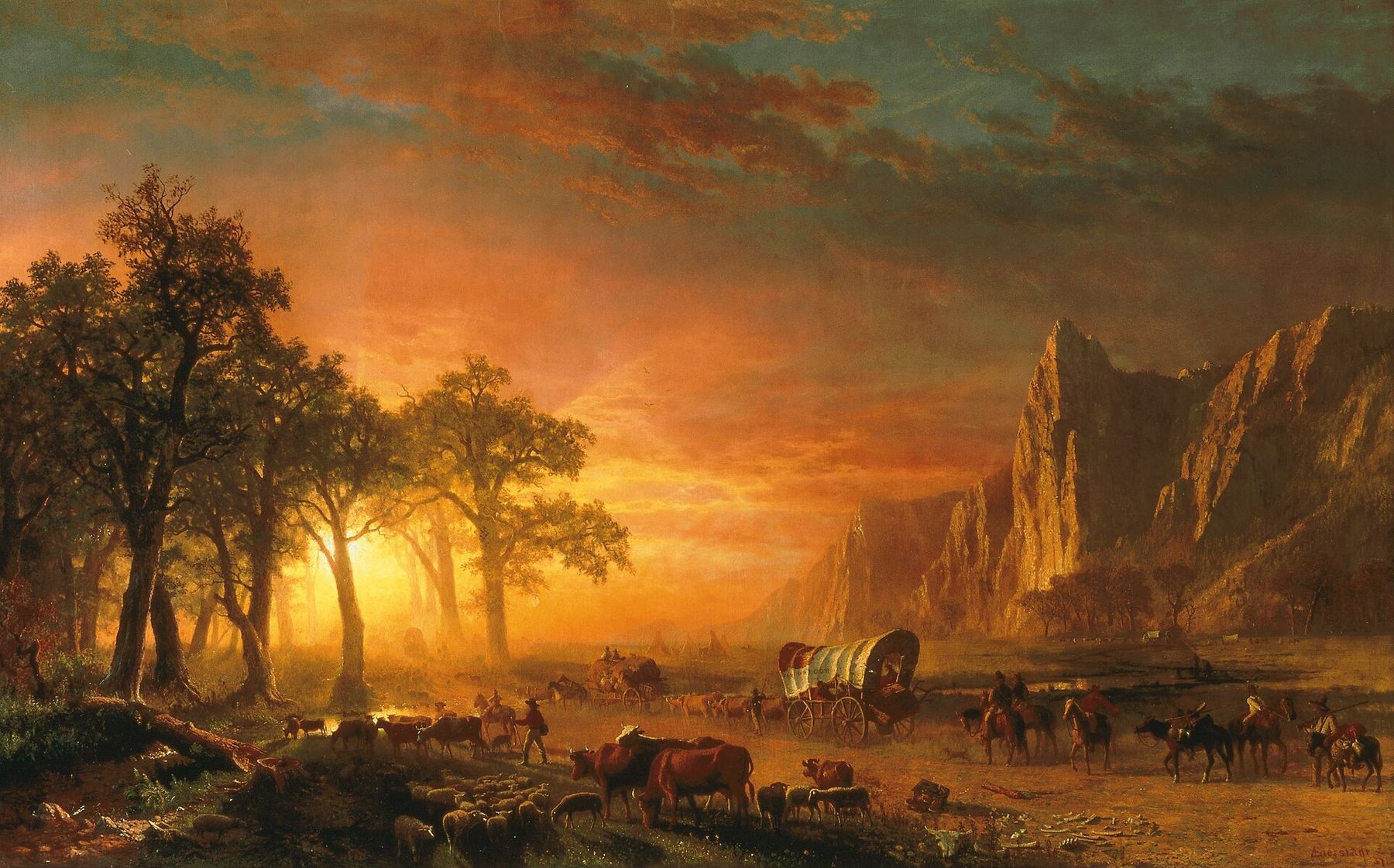
Bierstadt's emigrants heading west to claim land of their own.
Albert Bierstadt, Emigrants Crossing the Plains, 1867EcoAxes / Included ideologies / Conservative and traditionalist environmentalism
Political-economic doctrineLibertarian Environmentalism
The libertarian position that environmental harms violate property rights and should be put right by strict liability in the courts, since pollution is trespass. Private ownership of land, water and wildlife, with the state limited to enforcing rights, would protect the environment better than regulation, public ownership or international agreements.
- Key figures
- Murray Rothbard, Walter Block, Terry Anderson and Donald Leal (overlapping), Ludwig von Mises and Friedrich Hayek (antecedents)
Where it stands
- Environmental EthicsAnthropocentrismEcocentrism
- Human–Nature RelationsHuman SeparationHuman Integration
- Economic PhilosophyGreen GrowthPost-Growth
- Resource OwnershipPrivate StewardshipCommons Governance
- Environmental AuthorityCentralized AuthorityLocal Autonomy
- Environmental JusticeAggregate OutcomesDistributive Justice
- Technological OutlookTechnological OptimismEcological Precaution
- Energy PhilosophyEnergy AbundanceEnergy Sufficiency
- Conservation StrategySustainable UseStrict Protection
- Human–Wildlife RelationsHuman PriorityWildlife Accommodation
- Global ResponsibilityNational SovereigntyInternational Ecological Obligation
- Ecological Political PriorityIncremental ReformTransformative Change
Libertarian environmentalism is doctrinally explicit on property, the state, markets and sovereignty. Its justice value is uncertain because it rejects aggregate cost-benefit reasoning in favour of individual rights, which the axis does not capture well.
Definition
Libertarian environmentalism holds that the environment is best protected by applying libertarian principles consistently: self-ownership, private property and the principle that no one may initiate force against another.
Three conclusions follow. Pollution that crosses a property line is trespass or nuisance. It should be stopped by injunction and paid for under strict liability, whatever a cost-benefit calculation might say in its favour. Resources held in common are overused because nobody owns them, so they should be privatised. And government, the largest polluter and the owner of badly managed public lands, should be limited to enforcing rights.
It differs from mainstream free-market environmentalism mainly in two ways. It rejects any regulatory role for the state, and it justifies itself by rights, not by efficiency.
Historical development
The founding statement is Murray Rothbard’s “Law, Property Rights, and Air Pollution” (1982). Rothbard argued that nineteenth-century courts had been wrong to give up strict liability for pollution in favour of weighing its “social utility”. A return to strict property rights, he argued, would protect victims and discipline industry.
Walter Block’s edited volume Economics and the Environment: A Reconciliation (1990) and the literature of the Austrian school developed the position. The Property and Environment Research Center offered a version more grounded in evidence and closer to policy, in the free-market environmentalism of Terry Anderson and Donald Leal (1991). The doctrine has shaped libertarian party platforms and think-tank positions on public land, water and wildlife.
Principal claims
- Property rights, strictly enforced, protect the environment. Most environmental harm comes from failing to enforce them.
- Pollution is aggression against people and their property. The proper remedy is injunction and liability. Regulation is the wrong remedy.
- Common and public ownership leads to overuse and mismanagement, and privatisation cures them.
- The state is itself a major environmental offender and cannot be trusted as a guardian.
- International environmental agreements are illegitimate impositions on sovereign individuals and nations.
Policy implications
Libertarian environmentalists want regulatory regimes replaced by the law of torts. They want public land, water and wildlife privatised, environmental agencies abolished, and polluters held liable, governments included. They would withdraw from international environmental agreements and rely on markets, invention and wealth to improve the environment.
Internal disagreements
Libertarians disagree about whether strict liability for pollution, applied consistently, would shut down most industry. Rothbard accepted a threshold of proven harm. They differ on how to handle diffuse harms such as climate change, which cannot be traced to particular trespassers, on whether any public land should remain, and on how the position relates to anarcho-capitalism.
Criticisms and controversies
Critics argue that climate change, biodiversity loss and ocean acidification are exactly the harms that property and tort law cannot reach. They say privatising wildlife and water has concentrated them in few hands, that the doctrine ignores who gets what, and that the history of unregulated industry is a history of catastrophic pollution.
Libertarians answer that the historical courts were corrupted by doctrines that favoured industry, and that regulation has licensed pollution more than it has prevented it.
Relationships to other traditions
Libertarian environmentalism is the rights-based wing of free-market environmentalism and a distant relative of green conservatism’s localism. It is the opposite of commons governance, ecosocialism, eco-authoritarianism and planetary stewardship. From the other end of the political spectrum, it shares green anarchism’s rejection of the state, an overlap neither side is comfortable with.
References and further reading
- Rothbard, M. N. (1982). “Law, property rights, and air pollution.” Cato Journal 2(1), 55–99.
- Block, W., ed. (1990). Economics and the Environment: A Reconciliation. Fraser Institute.
- Anderson, T. L. and Leal, D. R. (2001). Free Market Environmentalism, rev. ed. Palgrave.
- Cordato, R. (2004). “Toward an Austrian theory of environmental economics.” Quarterly Journal of Austrian Economics 7(1), 3–16.