
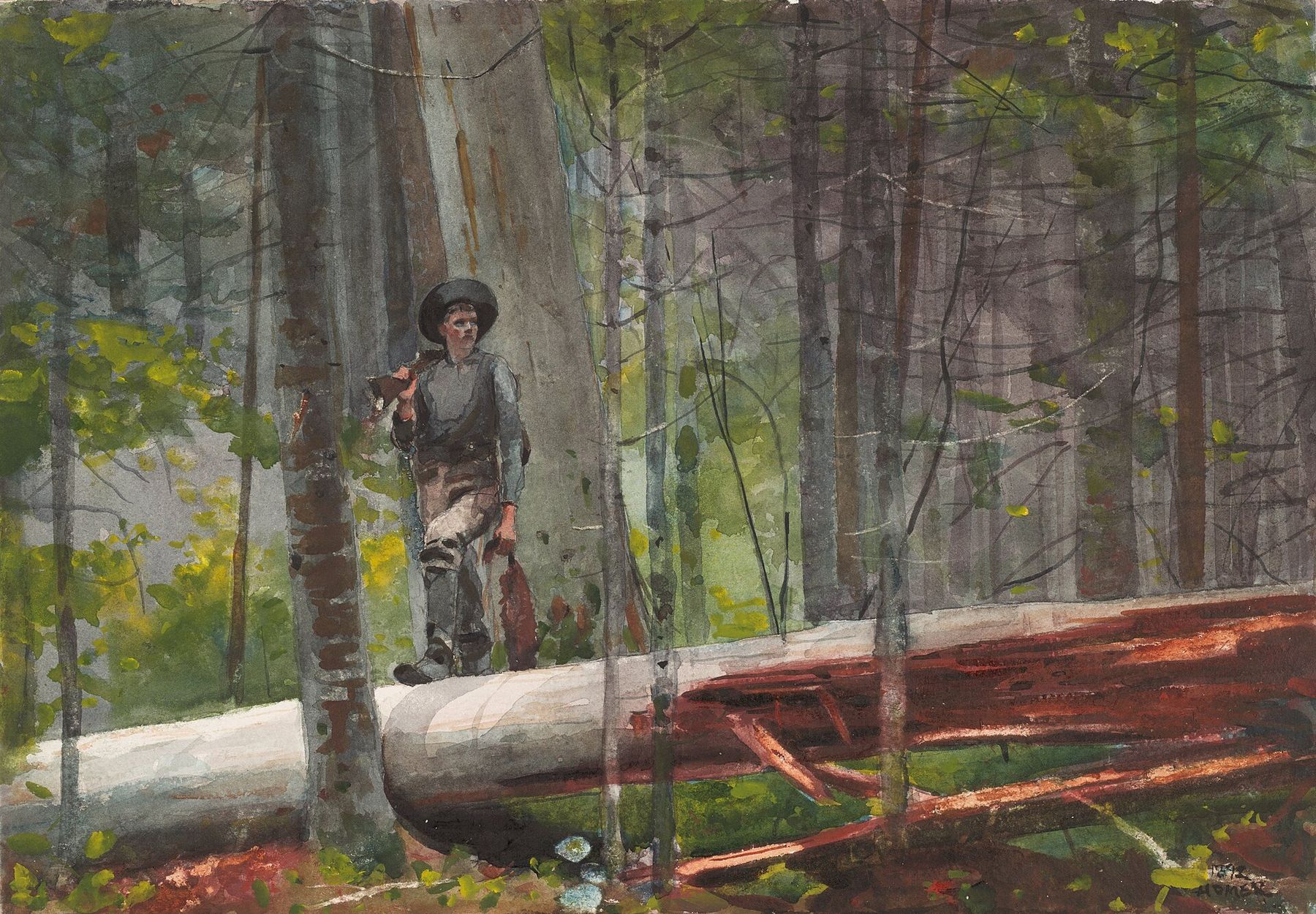
Homer's Adirondack hunters: a living made from the use of wild land.
Winslow Homer, Hunter in the Adirondacks, 1892EcoAxes / Included ideologies / Conservation philosophies and practice
Conservation approachSustainable-Use Conservation
The approach, built into the Convention on Biological Diversity and the work of the IUCN, that using wild species, through hunting, fishing, harvesting, trade and ranching, can be made sustainable and can create the incentives and money that conserve species and habitats. "Use it or lose it" is a legitimate conservation strategy alongside strict protection.
- Key figures
- Jon Hutton, Rosie Cooney, Marshall Murphree, Dilys Roe, the IUCN Sustainable Use and Livelihoods Specialist Group
Where it stands
- Environmental EthicsAnthropocentrismEcocentrism
- Human–Nature RelationsHuman SeparationHuman Integration
- Ecological InterventionNoninterventionActive Stewardship
- Economic PhilosophyGreen GrowthPost-Growth
- Resource OwnershipPrivate StewardshipCommons Governance
- Environmental AuthorityCentralized AuthorityLocal Autonomy
- Environmental JusticeAggregate OutcomesDistributive Justice
- Technological OutlookTechnological OptimismEcological Precaution
- Conservation StrategySustainable UseStrict Protection
- Human–Wildlife RelationsHuman PriorityWildlife Accommodation
- Agricultural EcologyLand SparingLand Sharing
- Global ResponsibilityNational SovereigntyInternational Ecological Obligation
- Ecological Political PriorityIncremental ReformTransformative Change
Sustainable use is explicit on conservation strategy, intervention and wildlife; it is market-friendly and reformist by disposition.
Definition
Sustainable-use conservation holds that wild species and ecosystems can be conserved by using them. Regulated hunting, fishing, logging, gathering of wild plants, trade in wildlife and game ranching, kept within biological limits, create economic value. That value gives landowners, communities and states a reason to keep wild populations and wild land, instead of turning the land to other uses.
It is one of the three objectives of the Convention on Biological Diversity (1992), alongside conservation and the sharing of benefits, and the IUCN has endorsed it in policy since 2000. Its supporters argue that bans, by taking away value, often harm the species they mean to protect, and that the usual alternative to a wildlife economy is a cattle economy.
Historical development
Game management as a science of sustained yield goes back to Aldo Leopold’s Game Management (1933), and to the fisheries concept of maximum sustainable yield. The modern position took shape in southern Africa in the 1970s and 1980s. There, laws handing ownership of wildlife to landowners, Zimbabwe’s Parks and Wild Life Act of 1975 and similar laws in Namibia and South Africa, allowed private game ranching, which reversed the decline of wildlife on commercial land. CAMPFIRE then extended the same logic to communities.
The IUCN’s 2000 Policy Statement on Sustainable Use of Wild Living Resources and its Sustainable Use and Livelihoods Specialist Group made the approach official. It has been fought over in CITES debates on ivory, rhino horn and trophy hunting, where protectionist and sustainable-use blocs oppose each other, and in Western arguments over bans on importing hunting trophies.
Principal claims
- Wild species kept as valuable assets survive. Species with no value get replaced.
- Regulated use within biological limits can be sustained, and it is widely practised.
- Money from hunting, trade and harvesting pays for conservation and gives local people a stake in it.
- Bans push use into illegal markets and remove incentives, so they often backfire.
- Active management, including culls and quotas, is a normal part of conservation.
Policy implications
The approach supports giving landowners or communities ownership of or rights over wildlife, regulated hunting and harvest quotas, and legal, traceable trade in wildlife. It favours game ranching and conservancies, sharing benefits with communities, and management that adapts to what monitoring shows. It opposes blanket bans on trade and imports.
Internal disagreements
Supporters disagree about whether trade in high-value products such as ivory and rhino horn is acceptable where enforcement is weak. They differ on trophy hunting as against other uses, on private as against community ownership, and on what to do about species whose decline was clearly caused by use.
Criticisms and controversies
Protectionists and animal welfare advocates argue that use makes killing respectable, that legal trade gives cover to illegal trade and stimulates demand, and that quotas are routinely exceeded. They say the money rarely reaches communities, and that the model has failed for many species, including most fisheries and many timber trees. Compassionate conservationists reject it on ethical grounds.
Supporters cite the recovery of southern African wildlife on land where it is used, and the failure of bans.
Relationships to other traditions
Sustainable-use conservation is the wildlife economics of conservationism and conservation conservatism, the foundation of CBNRM and a key current in community conservation. It is the direct opponent of wildlife protection, compassionate conservation and the strict protection of preservationism. It differs from free-market environmentalism only on whether the state should regulate.
References and further reading
- IUCN (2000). Policy Statement on Sustainable Use of Wild Living Resources. Resolution 2.29.
- Hutton, J. and Leader-Williams, N. (2003). “Sustainable use and incentive-driven conservation: Realigning human and conservation interests.” Oryx 37(2), 215–226.
- Cooney, R. et al. (2017). “From poachers to protectors: Engaging local communities in solutions to illegal wildlife trade.” Conservation Letters 10(3), 367–374.
- Child, B. (2019). Sustainable Governance of Wildlife and Community-Based Natural Resource Management. Routledge.
- Leopold, A. (1933). Game Management. Scribner’s.