
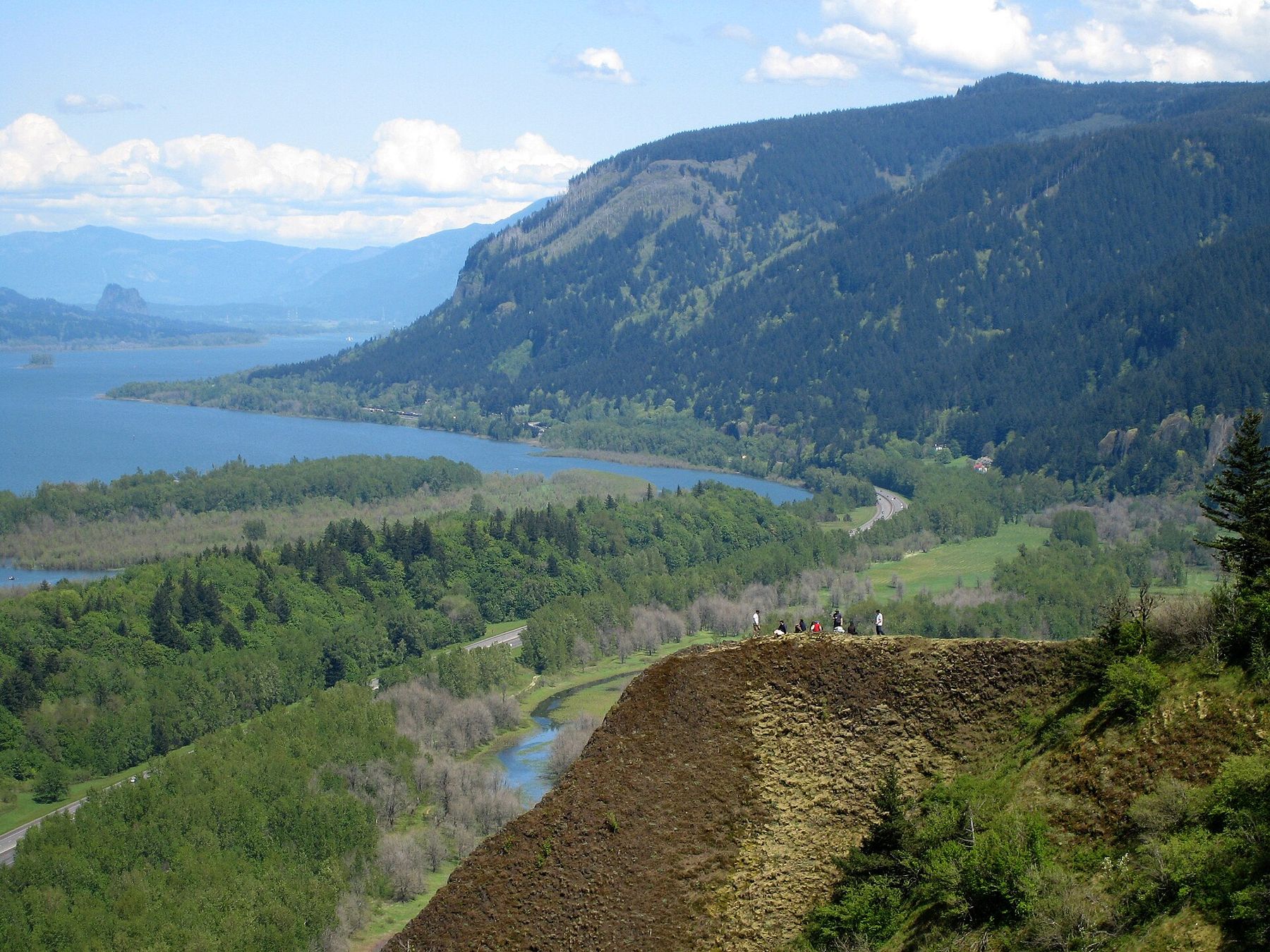
The Columbia River Gorge from Crown Point, in the Cascadia bioregion: a watershed as the shape of a community.
Hux, Columbia river gorge from crown point, 2009EcoAxes / Included ideologies / Classical environmental philosophies
Philosophy and movementBioregionalism
The view, developed in the 1970s by Peter Berg, Raymond Dasmann, Kirkpatrick Sale and Gary Snyder, that human life should be organised around natural regions such as watersheds, mountain ranges and ecosystems instead of political borders. Communities learn to "reinhabit" their place, live within its limits and govern themselves at the scale of the region.
- Key figures
- Peter Berg, Raymond Dasmann, Kirkpatrick Sale, Gary Snyder, Wendell Berry
Where it stands
- Environmental EthicsAnthropocentrismEcocentrism
- Human–Nature RelationsHuman SeparationHuman Integration
- Ecological InterventionNoninterventionActive Stewardship
- Economic PhilosophyGreen GrowthPost-Growth
- Resource OwnershipPrivate StewardshipCommons Governance
- Environmental AuthorityCentralized AuthorityLocal Autonomy
- Environmental JusticeAggregate OutcomesDistributive Justice
- Technological OutlookTechnological OptimismEcological Precaution
- Energy PhilosophyEnergy AbundanceEnergy Sufficiency
- Conservation StrategySustainable UseStrict Protection
- Human–Wildlife RelationsHuman PriorityWildlife Accommodation
- Agricultural EcologyLand SparingLand Sharing
- Global ResponsibilityNational SovereigntyInternational Ecological Obligation
- Ecological Political PriorityIncremental ReformTransformative Change
Its firmest commitments are to local and regional self-government, to people living within the ecology of their own place, to small-scale, low-energy economies and to farming woven into the land. It values nature for its own sake, sceptical of distant states and of global institutions, and seeks a transformation of how communities live rather than a political revolution.
Definition
Bioregionalism treats the natural region as the proper frame for human life and politics. A region is defined by its watersheds, landforms, climate, soils, plants and animals, and it has its own logic and limits. The people who live there should come to know it closely. As far as they can, they should take their food, water, energy and materials from it, repair what has been damaged, and govern themselves at that scale.
The central idea is “reinhabitation”: learning to live in a place as natives of it, as part of its life, instead of as visitors taking what they can. Borders drawn without regard to the land are, on this view, arbitrary. Rivers and mountains make better boundaries.
Historical development
Peter Berg and the ecologist Raymond Dasmann popularised the term. Their essay “Reinhabiting California” (1977) and Berg’s Planet Drum Foundation, founded in 1973, set out the programme. Kirkpatrick Sale gave it its fullest statement in Dwellers in the Land (1985). The poet Gary Snyder, in Turtle Island (1974) and The Practice of the Wild (1990), became its most influential voice.
North American Bioregional Congresses met from 1984. The ideas spread through the Cascadia movement in the Pacific Northwest, watershed councils across the American West, and bioregional planning and food movements in Europe and Australia.
Principal claims
- The true units of human community are natural regions. Political borders are not.
- People should know their place closely: its watershed, its soils, its native species and its history.
- Communities should meet their needs from their own region as far as possible and live within its limits.
- Government should be local and regional, with bioregions joined in a federation.
- The people who live in a damaged place should be the ones who restore it.
Policy implications
Bioregionalists support planning by watershed and watershed councils. They want local food and energy systems, regional currencies and economies, power handed down to communities, ecological restoration by local groups, and schooling grounded in local natural history. They distrust national and global institutions and long-distance trade.
Internal disagreements
One strand is cultural and stresses a change of consciousness and a sense of belonging to a place. Another is political and wants real regional self-government. Bioregionalists also disagree about how self-sufficient a region should be, and about their relationship with the Indigenous peoples whose knowledge of place they often draw on.
Criticisms and controversies
Critics say bioregions are hard to define and that regional self-sufficiency is unrealistic for crowded modern societies. Some warn that strong attachment to a region can slide into parochialism or hostility to newcomers. Indigenous critics have asked whether settler “reinhabitation” avoids the question of whom the land was taken from.
Supporters answer that bioregionalism is a way of looking at the world, not a blueprint, and that its focus on watersheds has shaped mainstream resource management.
Relationships to other traditions
Bioregionalism shares the commitment of social ecology and green anarchism to decentralised self-government. It shares agrarian conservatism’s love of place and of farming, and appropriate technology’s preference for the small and local. Its ecocentrism connects it to deep ecology, in which Snyder was a central figure.
References and further reading
- Berg, P. and Dasmann, R. (1977). Reinhabiting California. The Ecologist, 7(10), 399–401.
- Snyder, G. (1974). Turtle Island. New York: New Directions.
- Sale, K. (1985). Dwellers in the Land: The Bioregional Vision. San Francisco: Sierra Club Books.
- Snyder, G. (1990). The Practice of the Wild. San Francisco: North Point Press.
- Thayer, R. L. (2003). LifePlace: Bioregional Thought and Practice. Berkeley: University of California Press.
- Lynch, T., Glotfelty, C. and Armbruster, K. (eds.) (2012). The Bioregional Imagination. Athens: University of Georgia Press.