
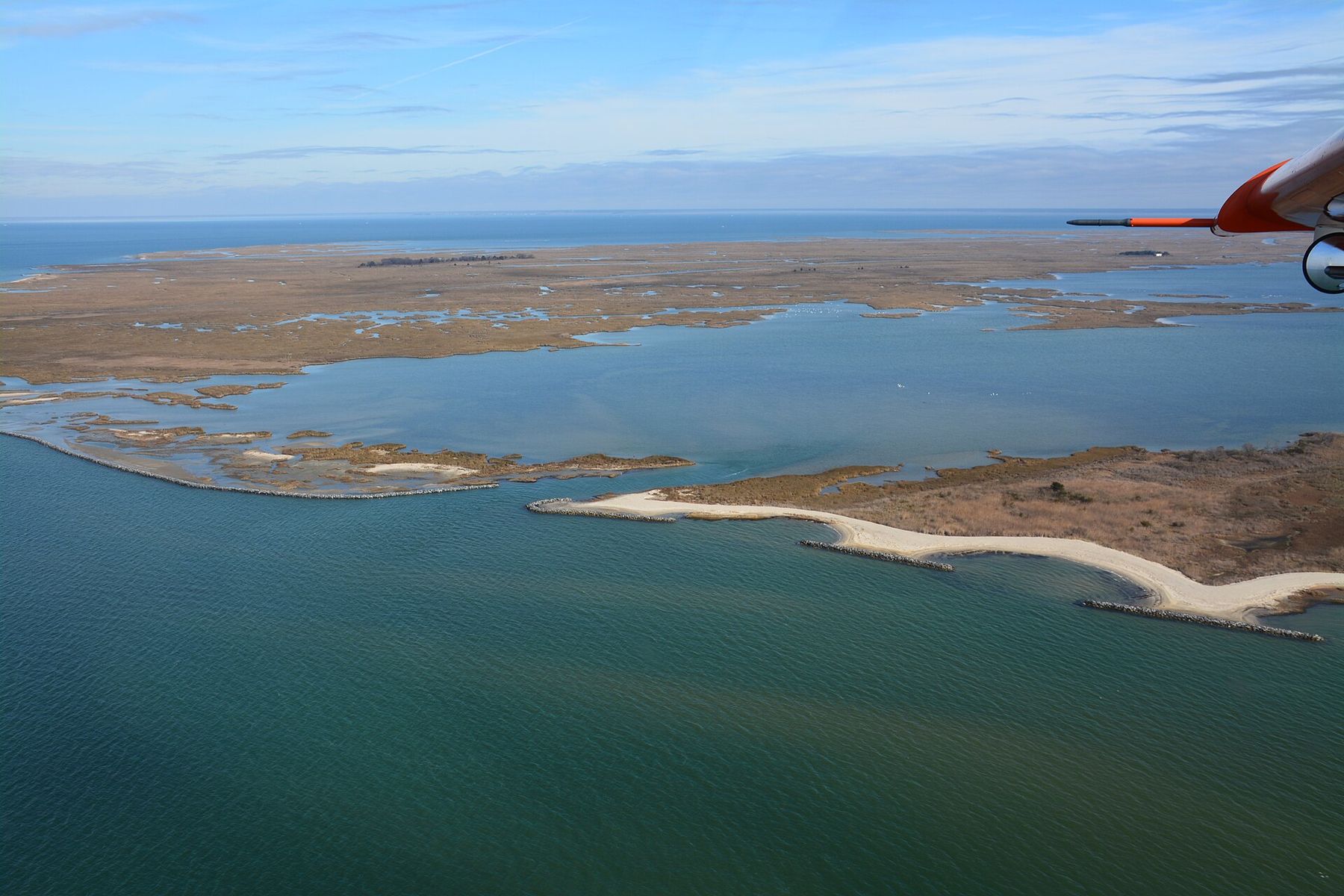
The Fog Point living shoreline, Chesapeake Bay: marsh rebuilt with sand and plants where it could be made to work.
U. S. Fish and Wildlife Service - Northeast Region, Aerial view of completed Fog Point Living Shoreline restoration at Glenn Martin National W, 2016EcoAxes / Included ideologies / Classical environmental philosophies
Philosophical and methodological positionEnvironmental Pragmatism
An approach to environmental ethics and policy that puts aside arguments about the ultimate value of nature. It prefers practical problem-solving, accepts many kinds of value, and tests policies democratically, like experiments, by their results.
- Key figures
- Bryan Norton, Andrew Light, Eric Katz (as editor and critic), Ben Minteer, Anthony Weston
Where it stands
- Environmental EthicsAnthropocentrismEcocentrism
- Ecological InterventionNoninterventionActive Stewardship
- Economic PhilosophyGreen GrowthPost-Growth
- Environmental AuthorityCentralized AuthorityLocal Autonomy
- Environmental JusticeAggregate OutcomesDistributive Justice
- Technological OutlookTechnological OptimismEcological Precaution
- Conservation StrategySustainable UseStrict Protection
- Ecological Political PriorityIncremental ReformTransformative Change
Pragmatism declines to settle most of these questions in advance, so every value except the preference for incremental, experimental reform carries a wide band.
Definition
Environmental pragmatism applies the philosophical pragmatism of Charles Sanders Peirce, William James and John Dewey to environmental questions. It makes three main moves.
First, it treats the long argument between anthropocentrism and non-anthropocentrism as idle in practice, since the two camps mostly agree on what to do. Second, it accepts that nature holds many kinds of value and does not force them into a single theory. Third, it judges environmental policies the way science judges hypotheses: by how well they work when tried, through open democratic discussion.
Historical development
Bryan Norton put forward the “convergence hypothesis” in Toward Unity Among Environmentalists (1991). A human-centred ethic that looks far enough ahead, he argued, will recommend the same policies as one that is not human-centred, so environmentalists should stop arguing about foundations and build coalitions. Andrew Light and Eric Katz’s edited volume Environmental Pragmatism (1996) gave the movement its name and gathered its arguments, including Katz’s own objections.
Norton developed a philosophy of adaptive management for environmental decisions in Sustainability (2005). Ben Minteer’s The Landscape of Reform (2006) traced a pragmatist line in American conservation thought through Liberty Hyde Bailey, Lewis Mumford, Benton MacKaye and Aldo Leopold.
Principal claims
- Agreeing on what to do matters more than settling arguments about intrinsic value.
- Nature holds many kinds of value, and which ones matter depends on the situation. No single theory captures them all.
- Environmental policy should be adaptive and experimental: act, watch what happens, learn and revise.
- Environmental choices should be settled by discussion among the people affected, not deduced from first principles.
- Philosophy’s job is to help practice, and that means speaking in terms the public and policymakers already use.
Policy implications
Pragmatists favour adaptive management, discussion among everyone with a stake, coalitions across ideological lines, and policies that can be revised as results come in. They tend to work within existing institutions and to distrust both technological utopias and calls for total transformation. They stay open to active intervention when the evidence supports it.
Internal disagreements
Pragmatists disagree about whether the convergence hypothesis is true. Norton’s critics think it rests on too hopeful a view of human self-interest. They differ on whether pragmatism is a method that fits any ethics or a position with content of its own, and on whether “what works” can be judged at all without some prior theory of value.
Criticisms and controversies
Eric Katz and Holmes Rolston argued that pragmatism gives up the one thing environmental ethics had to offer, the claim that nature has value in itself. They predicted that convergence would fail exactly where it counts, when human and non-human interests really conflict. Radicals see pragmatism as reformism with a philosophical gloss.
Pragmatists answer that decades of argument about foundations changed no policy, and that accepting many values and experimenting are the only honest responses to uncertainty.
Relationships to other traditions
Environmental pragmatism bridges weak anthropocentrism and ecocentrism and is a philosophical ally of green liberalism and sustainable development. It is critical of deep ecology’s search for foundations, and of any programme that claims to know the answer in advance.
References and further reading
- Norton, B. G. (1991). Toward Unity Among Environmentalists. Oxford University Press.
- Light, A. and Katz, E., eds. (1996). Environmental Pragmatism. Routledge.
- Norton, B. G. (2005). Sustainability: A Philosophy of Adaptive Ecosystem Management. University of Chicago Press.
- Minteer, B. A. (2006). The Landscape of Reform: Civic Pragmatism and Environmental Thought in America. MIT Press.